
Reconstruct Montgomery County Former Owners Backward
The Montgomery County Recorder keeps every conveyance that ties one owner to the next. Build a research table transfer by transfer, newest first. Each row must prove it reaches the same land.
| Backward Link | Name to Search Next | Parcel-Matching Evidence |
|---|---|---|
| Current acquiring deed | Its grantor | Legal description and newest recording date |
| Grantor's acquiring deed | That deed's grantor | Same lot, block, section, or metes-and-bounds tract |
| Earlier online transfer | Prior grantor | Book-page or instrument reference |
| Pre-web transfer | Name found in deed-book index | Recorder volume, page, and matching description |
| Historic context | Plat-book owner or resident clue | Year and page, kept distinct from proved title |
Not every record names a former owner. A mortgage, lien, easement, tax entry, or directory listing can explain the story around a parcel without proving who held title. Each owner row needs a conveyance or estate instrument.
Read Montgomery County's Deed Chain in Reverse
On Doxpop, search the receiving party as grantee, then use the transferor as the next backward key. Match legal descriptions, not names alone.
- Find the current owner's acquiring deed with that owner as grantee.
- Read the grantor, recording date, reference, and legal description.
- Search that grantor as an earlier grantee and verify the same tract.
- Repeat until online coverage ends, then continue through the Recorder's deed books or older media.
- Grantor
- The party transferring an interest.
- Grantee
- The party receiving an interest.
- Chain of title
- The ordered sequence of conveyances affecting one tract.
- Book/page versus instrument number
- Alternative retrieval references assigned to recorded documents.
Save Proof for Each Montgomery County Former Owner
View an available Doxpop image first. Request a plain or certified copy through the Recorder. The county's recorder fee schedule lists instrument, copy, certification, oversized-page, mortgage, and mechanic's-lien charges, so confirm the current amount before you order.
Recorded, not guaranteed. The Montgomery County index shows what reached the Recorder. It is not a title opinion and cannot rule out unrecorded interests.
Take the Former-Owner Chain Past the 1995 Web Line
The Doxpop partner table dates both Montgomery County index data and scanned images to January 1995. Treat 1995 as the dependable line. The Recorder publishes no pre-1995 web cutoff. A county report noted an older-document indexing project had reached mid-1942 in 2022, so ask the office directly about earlier results.
One misconception deserves correcting. The online index is not the whole deed archive. Counter research, telephone guidance, mail requests, deed books, and older media still matter for anything before the web era.
Open the Portal Used for Recent Prior Transfers
The live Doxpop portal is Montgomery County's online recorded-document route.
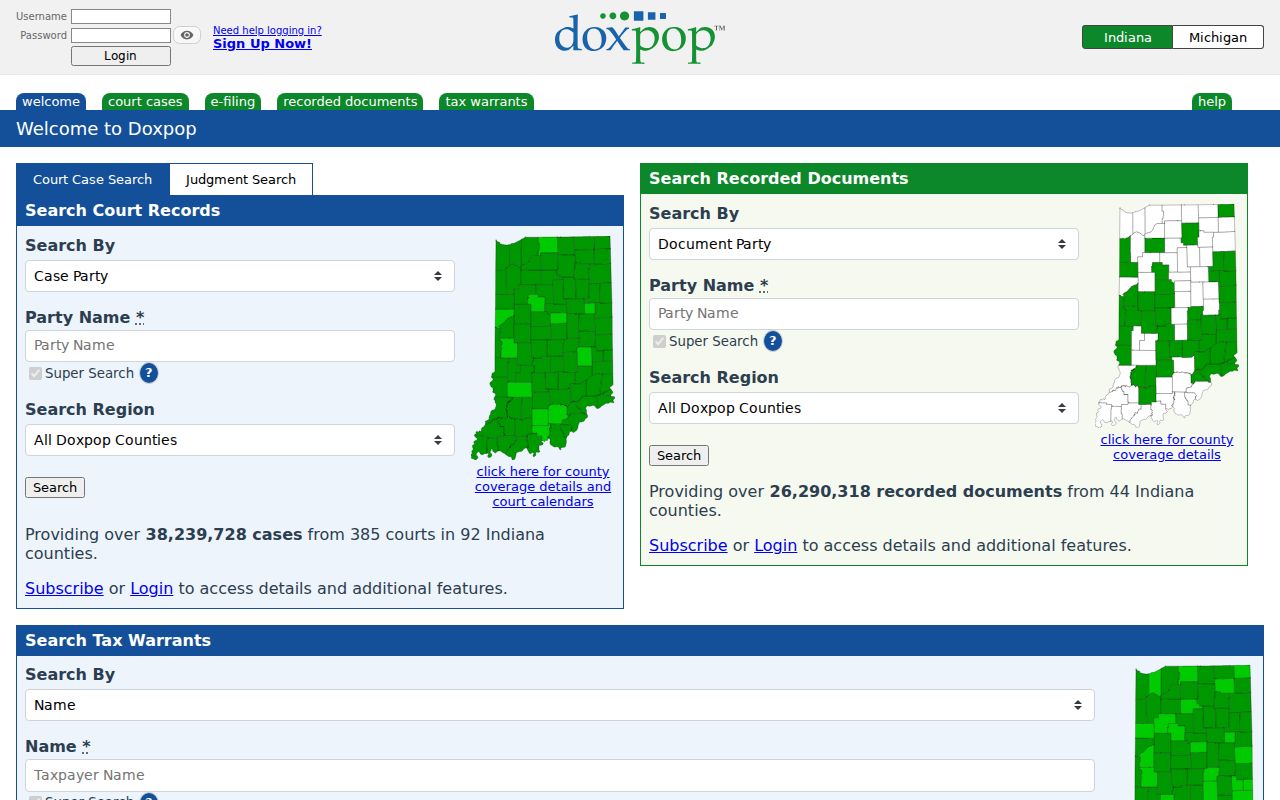
The image simply identifies the service. Search the live index and confirm Montgomery County before trusting any hit.
Use Plat Names as Historic Ownership Clues
The Crawfordsville District Public Library offers digitized assessor plat books plus a 54,110-entry name index. The Indiana State Library lists Montgomery County maps, atlases, and plats from 1864 through 2021. These sources surface historic names and land context. They never replace the recorded conveyance itself.
Search Each Previous Montgomery County Owner by Role
Doxpop is organized by documents and parties, not addresses. Start with the exact party spelling. Take it from the parcel card or a known deed, then narrow by Montgomery County and an estimated recording period. A name hit alone is not enough. People and entities can hold several parcels, so compare document type, recording date, instrument reference, and legal description before accepting any match.
| Search clue | How to use it | Verification |
|---|---|---|
| Grantee | Locate the instrument by which an owner received an interest | Match the tract description |
| Grantor | Locate a transfer out or step backward in the chain | Compare grantee and recording date |
| Document type | Separate deeds from mortgages, releases, liens, easements, and plats | Read the actual instrument |
| Instrument or book/page | Retrieve a known recorded item | Confirm county and page image |
| Date range | Reduce same-name results | Allow for recording after execution |
Execution and recording dates can differ. When ordering a copy, rely on the Recorder's stamp and assigned reference, not the date the parties signed.
Reach Older Former Owners Beyond the Web Index
The online index is one channel among several. Low-volume Doxpop searching can orient a researcher, while full service draws on an account, and image or subscription features may cost money. The Recorder counter can locate and provide documents. A phone call can settle the details first. A mailed request should name the county, the parties, the approximate recording date, and the document type. Add any known instrument or book-and-page reference. Say whether a plain or certified copy is needed.
When an ordinary office request does not fit, Indiana's Access to Public Records Act, Indiana Code 5-14-3, offers a formal route. Under section 5-14-3-9, an oral, telephone, or in-person request gets a response within 24 hours. One sent by mail, email, or fax draws an acknowledgment or response within seven calendar days. Those windows govern responses, not guaranteed document delivery. Fees must follow the applicable statutory or reasonable-copy rules.
For older context, the Crawfordsville District Public Library and Indiana State Library supply maps, directories, and plat references. The Indiana State Archives handles historical land, court, and other archival materials through its research contact route. These repositories point to clues. The Recorder remains the county's source for the recorded instrument.
Match Every Past Transfer to the Same Land
Surnames repeat. A landowner may convey only part of a tract. The legal description is your control. In platted areas, compare subdivision name, lot, block, and plat reference, while rural tracts may use section, township, range, or metes and bounds. Watch for easements describing only a strip or route, since a mortgage may also cover several tracts.
- Lot and block
- A description that depends on a recorded subdivision plat.
- Section, township, and range
- Public-land survey geography commonly used for rural context.
- Metes and bounds
- Courses and distances tied to monuments or points.
- Exception or reservation
- Language removing an area or retaining a stated right from the broader grant.
Splits and combinations complicate the trail. The modern tax number may never appear on an older deed for the same land. Don't force the current APN backward. Follow the legal description and plat history instead.
Review an Unexpected Transfer Without Assuming Fraud
The Recorder offers no fraud-alert enrollment. So don't chase a subscription link. None exists here. Owners worried about an unexpected instrument can periodically check the Recorder index, keep their recorded references, and call the office about a suspicious result. Even where alerts exist elsewhere, they only notify; they neither stop recording nor establish title.
Practical safeguard. Compare the exact owner spelling and legal description, not merely the street address, when reviewing newly indexed instruments.
Separate a Tax-Sale Stage from a Former Owner
The county's real-estate tax-sale page lays out eligibility and publication. It also covers the GIS tax-sale layer, payment, and redemption. Each step is a distinct event. Delinquency comes first, then the tax judgment, the advertisement, and the sale certificate. Any redemption comes next. A tax deed finally issues after that. Spotting a parcel in a tax-sale source does not mean the owner of record has already changed. The tax roll still shows the assessment owner until a recorded instrument says otherwise.
A tax deed in the Recorder index deserves a careful read. Check the instrument, the recording date, the legal description, and the named grantee. Then compare later deeds, court filings, and anything redemption-related. Recorded instruments only make sense in sequence and in the context of the exact tract. Pulling one deed out of order can mislead you fast.
Execution and recording dates often differ, so keep both. A deed signed near year-end may surface in a later recording-date search. Record the grantor and grantee exactly as indexed. Include the document type, instrument or book/page reference, and any exhibit. A parcel-card sale clue helps you pick a date window. It never replaces the image of the conveyance itself.
When requesting copies, say whether you need a plain copy or a certified copy. Confirm current charges against the Recorder's published fee schedule, and list each instrument separately. Oversized pages, plats, and attachments may need different handling. A precise request lets staff retrieve an existing record. It also keeps you from asking them to run an open-ended title examination.
An older deed may not carry the current parcel number. In that case, work from the full legal description and the plat history. Parcel splits and combinations can retire a tax identifier. The land description carries on through earlier instruments. The Mapping Department helps connect present and predecessor parcel numbers. The recorded chain, though, still lives in the Recorder's deed and plat references.