
What Montgomery County Deed Records Convey
The Montgomery County Recorder holds all conveyances and the land instruments filed beside them. Read the deed type before drawing conclusions, because the form describes the transfer itself rather than the quality of the title behind it.
| Deed Type | What It Does | Common Use |
|---|---|---|
| Warranty deed | Conveys the described interest with stated covenants | Ordinary arm's-length transfer |
| Quitclaim deed | Conveys whatever interest the grantor holds | Family or title-cleanup transfer |
| Special warranty deed | Uses more limited covenants | Transfer with limited assurances |
| Trustee or personal representative deed | Transfers under trust or estate authority | Trust and estate administration |
| Tax deed | Follows the statutory tax-sale process | Delinquent-tax parcel transfer |
A deed conveys an interest in land. Mortgages, mechanic's liens, and easements burden that interest instead, so search each related instrument type and confirm its legal description actually reaches the tract you care about.
Walk the Montgomery County Grantor-Grantee Index
Doxpop lets you search the receiving party as grantee first. Once that deed surfaces, treat the transferor as your next backward key, and match legal descriptions rather than trusting names alone.
- Find the current owner's acquiring deed with that owner as grantee.
- Read the grantor, recording date, reference, and legal description.
- Search that grantor as an earlier grantee and verify the same tract.
- Repeat until online coverage ends, then continue through the Recorder's deed books or older media.
- Grantor
- The party transferring an interest.
- Grantee
- The party receiving an interest.
- Chain of title
- The ordered sequence of conveyances affecting one tract.
- Book/page versus instrument number
- Alternative retrieval references assigned to recorded documents.
Obtain a Montgomery County Deed Copy
Check the Doxpop image when one is available. Order a plain or certified copy through the Recorder when official use requires it. The county's recorder fee schedule covers instrument, copy, certification, oversized-page, mortgage, and mechanic's-lien charges, so confirm the current amount before ordering.
Recorded, not guaranteed. The Montgomery County index shows what reached the Recorder. It is not a title opinion and cannot rule out unrecorded interests.
January 1995 Is the Dependable Online Line
The Doxpop partner table dates Montgomery County index data to January 1995. Scanned images start there too. Treat 1995 as the dependable web starting point. A county report placed an older-document indexing project at mid-1942 in 2022, but no current pre-1995 public cutoff was published. Ask the Recorder about anything earlier.
A common misconception says otherwise, but the online index is not the whole deed archive. Plenty of history lives in deed books and older media. Counter research, telephone guidance, mail requests, and those physical volumes remain real access channels. They matter whenever the web trail stops.
Recognize the Montgomery County Doxpop Route
The live Doxpop portal is Montgomery County's online recorded-document route.
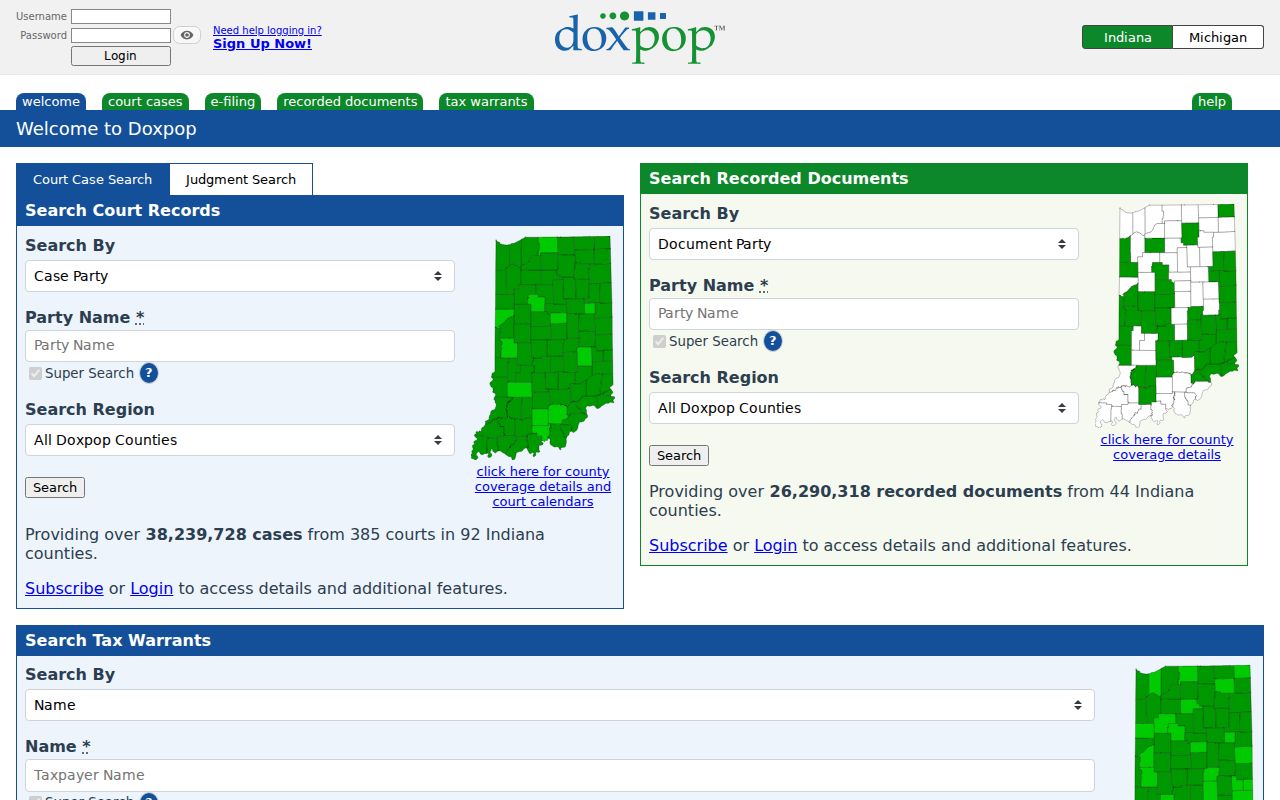
Doxpop's own pages identify the service clearly. Open the live index, confirm Montgomery County is selected, and only then rely on any deed hit.
Montgomery County Plat Books Bridge Older Research
The Crawfordsville District Public Library posts digitized assessor plat books along with a 54,110-entry name index. The Indiana State Library lists Montgomery County maps, atlases, and plats covering 1864 through 2021. Both are goldmines for historic owners and land context. Neither replaces the recorded conveyance itself.
Doxpop Deed Search Keys for Montgomery County
Doxpop is built around documents and parties, not addresses. Begin with a grantee or grantor spelling pulled from the parcel card or a known deed. Narrow the results to Montgomery County. Add an estimated recording period too. Then compare document type, recording date, instrument reference, and legal-description details before trusting any match, since an owner-name hit alone proves little when one person holds several parcels.
| Search clue | How to use it | Verification |
|---|---|---|
| Grantee | Locate the instrument by which an owner received an interest | Match the tract description |
| Grantor | Locate a transfer out or step backward in the chain | Compare grantee and recording date |
| Document type | Separate deeds from mortgages, releases, liens, easements, and plats | Read the actual instrument |
| Instrument or book/page | Retrieve a known recorded item | Confirm county and page image |
| Date range | Reduce same-name results | Allow for recording after execution |
Execution and recording dates can differ. When ordering a copy, cite the Recorder's stamp and the assigned instrument reference so the office pulls the right deed.
Every Route to a Montgomery County Recorded Document
The online index is just one door into the deed archive. Light Doxpop searching can orient you without an account, though image access and subscription features may cost money. The Recorder counter can pull documents on the spot. A phone call settles the correct request details before you drive over. Mail requests work too. Include the county, party names, approximate recording date, document type, any book or page reference, and whether you need a plain or certified copy.
Ordinary requests are not the only route. Indiana's Access to Public Records Act, Indiana Code 5-14-3, offers a formal path when an office request stalls. Section 5-14-3-9 sets a 24-hour response window. That applies to oral, telephone, and in-person requests. Mailed, emailed, or faxed requests earn acknowledgment or a response within seven calendar days. Those are response windows, not guaranteed delivery deadlines. Fees must follow the statutory or reasonable-copy rules.
Older context lives elsewhere. The Crawfordsville District Public Library and the Indiana State Library hold maps, directories, and plat references worth mining. The Indiana State Archives manages historical land, court, and archival materials through its research contact route. Those repositories supply clues; the Recorder remains the source for the county's recorded instrument.
Use the Legal Description to Keep the Chain on Track
Surnames repeat. One owner may convey only part of a tract. The legal description keeps the chain honest. In a platted area, compare subdivision name, lot, block, and plat reference; rural descriptions lean on section, township, range, or metes and bounds. An easement may describe only a strip, and a single mortgage can cover several tracts.
- Lot and block
- A description that depends on a recorded subdivision plat.
- Section, township, and range
- Public-land survey geography commonly used for rural context.
- Metes and bounds
- Courses and distances tied to monuments or points.
- Exception or reservation
- Language removing an area or retaining a stated right from the broader grant.
A modern tax number may not appear on older deeds. Splits and combinations renumber parcels over time. Follow the legal description and plat history instead of forcing today's APN backward.
No County Fraud-Alert Enrollment Was Located
The Recorder publishes no property-fraud alert enrollment service for Montgomery County. No subscription link exists to join. Owners worried about an unexpected instrument can check the Recorder index from time to time, keep their recorded references handy, and call the office about anything suspicious. Even where alerts exist elsewhere, they only notify. They neither stop a recording nor establish title.
Practical safeguard. Compare the exact owner spelling and legal description, not merely the street address, when reviewing newly indexed instruments.
A Tax-Sale Entry Is Not Immediately a Tax Deed
A parcel can surface in a tax-sale listing long before any deed changes hands. The county's real-estate tax-sale page walks through eligibility and publication. It also covers the GIS tax-sale layer, payment, and redemption. Each step is its own event. Delinquency comes first, then the tax judgment, the advertisement, and a sale certificate. Redemption may follow, and only then, sometimes, a tax deed. A tax-sale entry alone does not mean the assessment owner has already lost the land.
If a tax deed does show up in the Recorder index, slow down. Read the instrument itself, the recording date, the legal description, and the named grantee. Compare everything against later deeds, court filings, or redemption information. That keeps the central rule of deed research intact. Recorded instruments must be read in sequence and in the context of the exact tract.
Execution and recording dates can differ, so record both. A deed signed near year-end may not surface until a later recording-date search. Save the grantor and grantee exactly as indexed. Note the document type and the instrument or book/page reference too. Keep any attached exhibit. A parcel-card sale clue helps narrow the date window. It still does not replace the image of the conveyance itself.
Copies come in two flavors. Decide up front whether a plain readable copy or a certified copy is needed. Confirm current charges against the Recorder's published fee schedule, and list each instrument separately. Oversized pages, plats, and attachments may call for different handling. A precise request lets staff retrieve an existing record. Staff need not run an open-ended title examination.
Older deeds often lack the current parcel number. In that case, work from the full legal description and plat history. Splits and combinations can retire a tax identifier. The land description carries on through earlier instruments. The Mapping Department can link present and predecessor parcel numbers. Even so, the Recorder's deed and plat references remain the recorded chain.