
Read Montgomery County Property Tax Records
Use the Assessor, Auditor, and Treasurer as linked but distinct custodians.
| Field | What It Shows | Where |
|---|---|---|
| Land, improvement, total assessment | Components used in the county assessment | Assessor parcel record |
| Market value-in-use | Indiana's market-based assessment standard | Assessor and DLGF guidance |
| Deductions | Homestead, over-65, blind or disabled, veteran, and geothermal relief | Auditor |
| Tax bill and status | Charges, due dates, payments, and delinquency | Treasurer |
| Sale or judgment status | Publication, certification, sale, or redemption stage | Treasurer and Auditor |
A Montgomery County property tax record is really several records linked by one parcel number. The Assessor sets the property characteristics and value. The Auditor applies deductions and handles tax administration. The Treasurer issues the bill and collects payment. Reading the whole chain takes care. Search Montgomery County property tax records by address or parcel number. That pulls the pieces together. Keep the assessment year separate from the payable year. Match the record against the notice before an appeal or a tax-sale question. Each office answers only for the piece it keeps.
Look Up a Montgomery County Tax Bill
Begin in WTHGIS or on Beacon and copy the parcel number. Then trace the county-linked payment history, and let the Treasurer confirm current status.
- Search WTHGIS or the county-linked Beacon route by address, owner, or parcel.
- Copy the exact parcel key and open the payment-history or bill route.
- Compare the assessment year, land, improvement, total, and deductions.
- Confirm the current balance, delinquency, judgment, or sale stage with the proper office.
- Assessed value
- The Assessor's value within Indiana's market value-in-use system.
- Tax rate or levy
- The rate applied within the parcel's taxing districts.
- Homestead deduction
- A qualifying deduction administered through the Auditor.
- Tax lien
- A public claim arising from unpaid property taxes, distinct from a completed tax deed.
Contest a Montgomery County Assessment
Indiana DLGF's appeal guidance walks through Form 130 and the PTABOA route. Bring the notice, parcel card, photographs, measurements, comparable sales, and any document tied to the disputed fact.
Check the current deadline. File Form 130 within the deadline printed on the notice or stated in current DLGF guidance; do not rely on an older calendar.
Montgomery County Deductions Belong with the Auditor
The county's deductions page routes homestead, over-65, blind or disabled, and veteran relief to the Auditor. Geothermal and similar relief go there too. After a transfer or eligibility change, verify the deduction on the current parcel record. File with the current DLGF form catalog. Keep the filed form, the Auditor confirmation, the parcel number, and the effective assessment year together. A later bill can then be checked against the approved deduction.
2024 Trending Changed Assessment Inputs
Assessor meeting material reported an approved ratio study. It also listed changed land values, new location cost multipliers, and trending values for 2024 payable 2025. So a record can change with no deed transfer and no building project. Compare the same assessment years. Then pin down whether land, improvements, deductions, or tax charges drove the difference.
Montgomery County Tax Payment Channels
Payment is not limited to one portal. Statements normally go out in mid-April. County guidance sets May 10 and November 10 as spring and fall due dates. A due date moves to the next business day when it lands on a weekend or holiday. Online bill pay searches by parcel, name, or address. Phone payment needs the parcel number and runs through 855-276-8051. Service fees apply to online and phone transactions.
The Treasurer's office in Suite B at 1580 Constitution Row takes payments in person. Hours are weekdays from 8 a.m. to 4:30 p.m. A courthouse drop box, mail, and participating banks also work. Follow the county's current mailing instructions. A postmark, a returned payment, or a missing parcel reference can affect processing. Keep the confirmation with the bill year and parcel number.
Annual Trending and Cyclical Review in Montgomery County
Indiana assessment work pairs annual adjustment with a cyclical review. State guidance sets a January 1 assessment date. It calls for yearly trending toward market value-in-use, and review of roughly one quarter of parcels each year of a four-year cycle. That is why a Montgomery County assessment can change in a year with no sale.
Read the notice component by component. A land change may trace to updated land values or a location multiplier. An improvement change may reflect grade, condition, square footage, or newly recognized work. Deduction changes belong with the Auditor, not the Assessor's physical description. For a factual error, gather measurements, photographs, deeds, permits, or other objective support. For a value dispute, recent comparable sales and property-class consistency carry the argument. Form 130 opens the local review. PTABOA and the state route come after it when needed.
Tax Sale Status Requires a Stage-by-Stage Check
Montgomery County material ties tax-sale eligibility to a parcel sitting three installments behind. It also lists a $150 tax-sale charge. The county publishes information locally and through SRI, and WTHGIS carries a tax-sale layer. None of those clues equals a deed transferring title. A parcel moves through delinquency, judgment, certification, advertisement, sale, and redemption. Any payment shifts its status along the way.
Ask the Treasurer for the current amount and payment history. Ask the Auditor about certificate or redemption administration. Search the Recorder only when the question is whether a tax deed or related instrument was recorded. Keep the owner of record distinct from whoever owes the payment. Official confirmation matters most near a sale or redemption deadline.
Separate Delinquency from a Tax Deed
The county's tax-sale page covers eligibility, newspaper and SRI publication, a GIS sale layer, payment, and redemption. Its tax judgments page adds delinquent-certification context. A balance, judgment, advertisement, certificate sale, redemption, and tax deed are distinct stages.
Use Indiana's Current Appeal Route
The official DLGF appeal page is the current state guide.
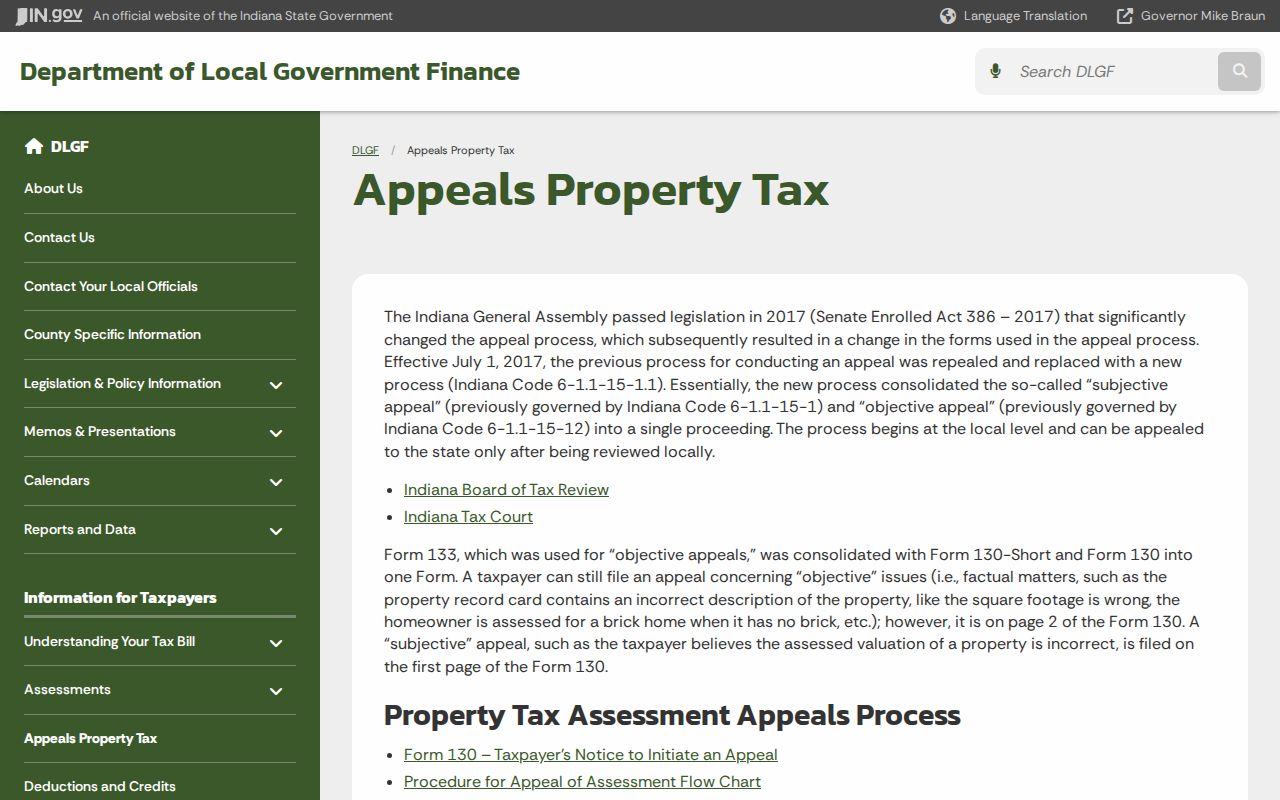
The captured page points to the live procedure and forms; confirm each requirement there before filing.
Match the Assessment Year to the Payable Year
Montgomery County property tax records pair an assessment year with a later payable year. Keep both labels with any figure you copy. A valuation dated January 1 feeds the billing cycle that follows. Treat 2024 payable 2025 and a 2025 payment entry as different stages, not twins. The bill, the assessment notice, the parcel card, and a payment confirmation are separate records. Each captures a different moment.
Line up a chronology before questioning a jump. List the assessment date, the notice date, deduction status, and installment due dates. Add payment dates and any appeal filing. The Assessor handles land, improvements, classification, and trending questions. The Auditor covers deductions and transfer administration. The Treasurer confirms billed amounts, receipts, delinquency, and how payments were applied. Splitting the questions this way keeps you from asking one office to read another custodian's field.
Requesting a prior year takes three items. Bring the parcel number, the indexed taxpayer or owner name, and the exact payable year. Specify the record type you want, whether a statement, payment ledger, delinquency entry, judgment record, or certified copy. If the portal does not expose that year, ask for the existing record directly rather than treating the current screen as a full tax history.
Save any downloaded or printed copy with its retrieval date. Portal figures can shift after a payment, a corrected assessment, a deduction update, or a redemption.
Correct a Montgomery County Tax Record at Its Source
Sort the mismatch before filing anything. An owner spelling error may need a comparison with the newest Recorder instrument. An unposted transfer may need one too. A wrong building characteristic or land figure belongs to the Assessor. A missing deduction belongs to the Auditor. A payment or balance dispute goes to the Treasurer. Mapping handles parcel-shape and address problems.
Bring the same core evidence to whichever office holds the record. That includes parcel number, situs, owner name exactly as displayed, assessment and payable years, notice or bill number, and the field you believe is wrong. Attach the supporting document you already have. This could be a deed, receipt, photograph, measurement, or permit. Ask whether the office prefers a correction form, an appeal, or an administrative update. An email question does not preserve an appeal deadline.
Indiana APRA can obtain an existing card, ledger, notice, or index entry. It does not force an office to build a custom tax analysis. Oral, in-person, or telephone requests get a response within 24 hours. Written requests by mail, email, or fax receive acknowledgment within seven calendar days. They can also receive a response within that window. Those clocks govern response, not a universal production deadline. A narrow request naming the parcel, year, record type, and desired electronic or certified format is easier to process. It is easier to verify as well.
Before leaning on a Montgomery County property tax record, save the details behind it. Note the portal date, parcel number, assessment year, payable year, and any office confirmation. That compact source trail shows whether a later difference came from valuation, a deduction, billing, payment, or tax-sale administration. It also gives the custodian enough detail to pull up the very same entry.